Introduction: The Mortal Holy Monk on the Western Pilgrimage
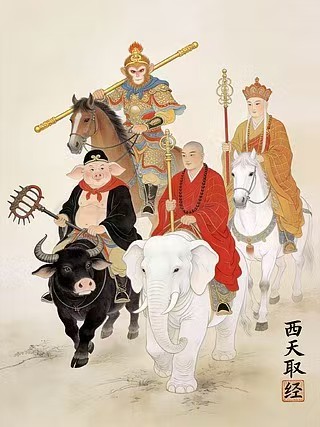
“Journey to the West” is not merely a novel of gods and demons; it is an encyclopedia of life, spiritual practice, and human nature. In the pilgrimage team, Sun Wukong’s immense powers, Zhu Bajie’s lovable antics, and Sha Wujing’s unwavering loyalty each possess unique charm. However, the one who truly connects the entire story and propels the grand journey westward is the seemingly weakest and most incompetent mortal—Tang Sanzang. He possesses no physical prowess, yet he bears the divine mission of universal salvation. He is a mortal, yet he embodies the holy monk’s compassion; he is filled with attachments, yet these very attachments forge an indomitable vow; he manages a team of diverse personalities, demonstrating a unique art of leadership. What profound wisdom of spiritual practice and high-dimensional insights does Tang Sanzang, this mortal holy monk on the Western journey, truly embody?
I. Mortal Body, Sacred Mission: The Coexistence of Fragility and Purity
Tang Sanzang is the only mortal in the pilgrimage team. His physical body is fragile, unable to withstand wind and rain, much less the temptations and threats of demons and monsters. He is often captured, hung, and prepared for consumption, requiring his disciples to rescue him time and again. This physical fragility is the most direct manifestation of his “human” attribute. On the path of spiritual growth, we often aspire to transcend the limitations of the physical body and reach a transcendent state, yet we forget that the body itself is a sacred temple housing the soul, and its fragility is part of the spiritual journey.
Nevertheless, Tang Sanzang’s body is endowed with the setting of “a reincarnation of Golden Cicada” and “a good person who has cultivated for ten lifetimes,” making his flesh “pure Yang” and thus considered by demons as a miraculous elixir for immortality. This seemingly contradictory setting actually reveals a profound high-dimensional truth: the mortal body and sacred mission can coexist and even mutually fulfill each other. Our bodies, even with their limitations, are perfect vessels for carrying the light of our souls and manifesting our divine purpose.
- High-Dimensional Revelation: Everyone possesses a “mortal body,” which represents our limitations, weaknesses, and vulnerable aspects in the three-dimensional world that need protection. Simultaneously, each of us carries a “sacred mission,” a unique talent and contribution already set in our soul blueprint. Tang Sanzang’s story reminds us that there’s no need to deny the existence of the physical body or its sensations. Instead, we should learn to accept this fragility, and on this foundation, through inner purity and vows, realize the highest guidance of the soul. His “pure Yang” body symbolizes inner clarity, purity, and high-frequency vibration. This intrinsic quality is the true secret of “immortality,” an energy field that attracts cosmic abundance and divine protection.
II. The Test of Attachments: From Form to the Epiphany of Truth
Tang Sanzang’s journey to the West is also his path of cultivating the release of various “attachments.” His attachments, at times extensions of compassion, at other times become obstacles to his practice.
- Emotional Attachment and Worldly Temptations: In the Women’s Kingdom, Tang Sanzang faced the deep affection of the queen and the temptation of worldly pleasures, struggling internally. This emotional attachment is the most common human experience, symbolizing our longing for and entanglement in intimate relationships and secular emotions. Tang Sanzang’s ultimate refusal was not heartlessness, but his choice to elevate personal love to universal love, transforming individual emotional attachment into a grand vow for universal salvation.
- Attachment to Authority and Rules: As a Buddhist monk, Tang Sanzang strictly adhered to precepts and authority (such as the instructions of Guanyin Bodhisattva). He often judged Sun Wukong’s “wildness” and “disobedience” by fixed Buddhist doctrines, frequently reciting the Golden Fillet Spell, and even expelling Sun Wukong. This reflects how, in the early stages of spiritual practice, we often cling to external forms, dogmas, and manifested authority, overlooking inner wisdom and adaptability.
- Attachment to the “Scriptures” as Form: Throughout the entire pilgrimage, Tang Sanzang’s goal was always to obtain the “true scriptures.” However, after enduring countless hardships, when he finally received the “Wordless Scriptures” at the Spiritual Mountain, he was first bewildered, then experienced an epiphany. The appearance of the “Wordless Scriptures” is one of the most high-dimensionally revelatory passages in “Journey to the West.” It symbolizes that: true truth transcends all words and forms. All scriptures, teachings, and methods are merely pointers to the moon, not the moon itself.
- High-Dimensional Revelation: Everyone harbors various “attachments.” These can be our expectations for certain outcomes, our emotional dependencies, or our adherence to specific beliefs. Tang Sanzang’s spiritual journey teaches us that attachments themselves are not entirely negative; they can sometimes be the driving force that propels us forward (like his attachment to obtaining the scriptures). However, when they transform into rigid, restrictive thinking, they become shackles on our growth. True liberation lies in learning to let go of attachment to external forms and turning towards inner experience and enlightenment. The ultimate “Wordless Scriptures” are the cosmos telling us that the highest wisdom cannot be fully expressed in words; it requires us to feel, experience, and become it with our hearts. When we release our attachment to “scriptures with words,” we can truly understand the profound meaning of the “Wordless Scriptures”—truth resides within us, no external seeking is needed.
III. The “Boss” in the Team: The Art of Reliance and Management
As the “boss” of the pilgrimage team, Tang Sanzang’s leadership style was full of contradictions and tensions. He relied on his disciples’ divine powers, yet often managed them with the “Golden Fillet Spell” and mortal moral standards.
- Management Style: Spells and Empty Promises: Tang Sanzang’s “Golden Fillet Spell” for Sun Wukong was his most direct means of control. This symbolizes the “hard management” approach leaders sometimes adopt when dealing with powerful and challenging subordinates. His promise of “achieving Buddhahood” to his disciples was the biggest “empty promise”—a distant and vague vision. Yet, it was this vision that maintained team cohesion and motivated the disciples to overcome all difficulties.
- Reliance and Management of Team Members:
- Sun Wukong’s “Performance”: Sun Wukong was the team’s “core operational backbone,” responsible for subduing demons and contributing the vast majority of “performance.” Tang Sanzang had a love-hate relationship with Sun Wukong; he couldn’t do without his abilities, yet often punished him for his impulsiveness. This reflects the complex emotions of leaders towards “talented individuals”—needing to utilize their talents while also finding ways to manage their personalities.
- Zhu Bajie’s “Flattery” and Worldliness: Zhu Bajie represents the “average employee” in the team; he was lazy, pleasure-seeking, prone to complaining, and sometimes flattering. Tang Sanzang’s tolerance for him, to some extent, was an understanding and acceptance of human nature. He knew that the team needed such worldly presences to balance an overly idealistic atmosphere.
- Sha Wujing’s “Loyalty” and Stability: Sha Wujing was the “foundation” of the team; he worked tirelessly and was fiercely loyal, the most stable force in the team. Tang Sanzang’s trust in Sha Wujing was an acknowledgment of and reliance on the “silent contributors” within the team.
- The Essence of Leadership: Tang Sanzang’s leadership was not based on personal ability or charisma, but on his sacred mission and unwavering vow. He didn’t have the ability to solve problems, but he had the ability to pose the problem (the pilgrimage) and trust that the team could solve it. He deeply understood his weaknesses, thus knowing how to rely on others’ strengths and inspire team potential by establishing a common goal.
- High-Dimensional Revelation: Everyone possesses an “inner boss” aspect, representing how we manage our internal resources (thoughts, emotions, behaviors) and external relationships. Tang Sanzang’s leadership teaches us that true leadership is not about controlling others, but about igniting others’ inner power and providing them with a vision worth following. His “spells” are calibration for inner imbalance, and his “empty promises” are infinite trust in future possibilities. In teamwork, one must learn to accept the existence of different personalities, understand how to teach according to individual aptitude, and, most importantly, trust the team’s strength. Ultimately, a leader is one who can gather the energy of all members into a powerful collective force.
IV. Cowardice and Resilience: A Symbol of Faith and Vows
Superficially, Tang Sanzang appears cowardly. He often wept, complained, and was helpless in the face of demons. However, beneath this superficial cowardice lay an unparalleled resilience and faith.
- Inner Steadfastness: No matter how many hardships he encountered, Tang Sanzang never truly abandoned the idea of obtaining the scriptures. Even when Sun Wukong left in anger or when he was captured by demons, his ultimate goal remained “traveling to the West to obtain scriptures for universal salvation.” This inner steadfastness was a manifestation of his core belief and grand vow.
- The Power of Vows: Tang Sanzang’s vow was the fundamental support that enabled him to complete the ten-thousand-mile journey. Every time he was rescued, every time he resumed his journey, stemmed from his deep compassion and vow for Buddhism and all sentient beings. This vow transcended physical pain and mental setbacks, becoming a powerful driving force.
- The Appearance of “Cowardice” and the Core of “Resilience”: His “cowardice” was not true weakness but a natural expression of mortal emotions. It was precisely against the backdrop of these mortal emotions that his transcendent resilience and vow appeared even more real and moving.
- High-Dimensional Revelation: Everyone possesses a “Tang Sanzang” aspect within them, representing our original intention, our purest compassion, and the vulnerability deep within our hearts that needs protection. On the path to pursuing dreams and fulfilling missions, we too will encounter various seemingly “insurmountable” obstacles, giving rise to fear, doubt, and retreat. Tang Sanzang’s story teaches us that there is no need to deny these “cowardly” feelings; they are part of human nature. True resilience is not about becoming invulnerable but about choosing to believe, choosing to move forward, and holding fast to our vows even while feeling vulnerable. This faith and vow, emerging from the depths of our hearts, are our most powerful strength, capable of guiding us through all illusions and challenges.
V. High-Dimensional Revelation: Our Inner “Tang Sanzang”
Tang Sanzang, as a character, transcends simple good and evil, becoming a multidimensional life mentor. He reminds us to:
- Return to Original Intention and Compassion: Our inner “Tang Sanzang” represents our original intention and pure heart of compassion. In the complexities of worldly life, can we still maintain that initial love and kindness for life?
- Embrace Vulnerability, Safeguard Purity: Our vulnerable aspects need to be seen, accepted, and protected. It is this very vulnerability that allows us to empathize with others and ignite our inner pure strength.
- Release External Control, Turn to Inner Trust: True spiritual practice is about learning to let go of attachment and control over external outcomes and others’ actions, and instead trusting our inner wisdom and the perfect arrangement of the universe. Just as Tang Sanzang ultimately understood the “Wordless Scriptures,” the highest wisdom needs no external seeking; it already resides within us.
- The Power of Vows and Belief: No matter how external circumstances change, as long as we hold a clear vision and firm belief in our hearts, guided by love, the universe will attract the necessary resources and support to help us fulfill our highest mission.
Conclusion:
Tang Sanzang’s journey to the West is a pilgrimage from mortality to awakening, and a profound spiritual practice concerning compassion, attachment, and leadership. Through his unique life trajectory, he shows us how to discover strength in vulnerability, seek transcendence in attachment, and achieve a common vision within a team. Each of us is a “Tang Sanzang” in our own life journey, bearing a unique mission and holding inner wisdom. When we learn to embrace all aspects of ourselves, release limiting beliefs, and guide ourselves with cosmic love, we too can ultimately obtain our own “true scriptures” and achieve the fulfillment and awakening of life.
“Received value? Support the journey and contribute to more sacred offeringshere:” https://www.patreon.com/daohuiwisdom/posts/ascension-from-163320761
WeChat Pay / Alipay (For Overseas Chinese Users)
This is a personal collection QR code, suitable for WeChat/Alipay users who have activated a Chinese mainland bank card or certain international payment functions.
Please use your WeChat/Alipay App to scan the QR code for payment.
After payment, please notify us via email at maryheyingmei@163.com so we can confirm your payment.

Leave a Reply