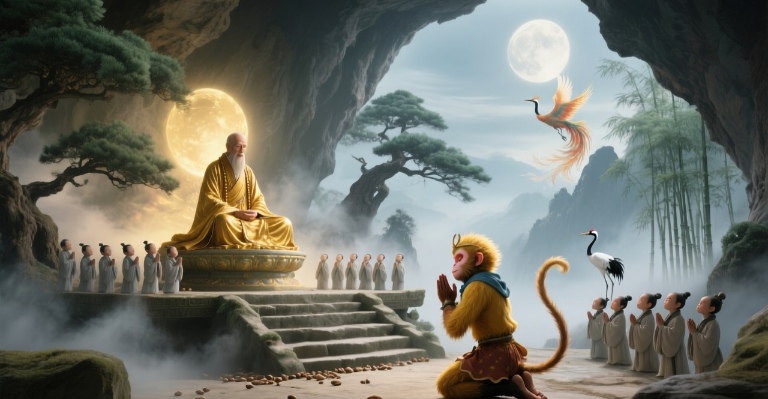
Rebellion and Giftedness:
The mighty supernatural powers and unruly defiance of Sun Wukong represent the untamed primal force within us.
Beneath Sun Wukong’s quest for the Dao and arduous cultivation of formidable abilities lies an integrated dual core: one is the longing for autonomy and freedom, while the other is a deep‑seated unease — refusing to place his destiny in the hands of others.
1. Why he strove with all his might to master extraordinary skills
He crossed vast oceans and endured untold hardships to seek Patriarch Bodhi. His original aspiration was to break free from the sway of birth, aging, sickness, death and fate.
Applied to the inner world of ordinary people:
Many people devote themselves to learning diverse skills and honing themselves, developing traits of self‑reliance and bearing everything alone. On the surface, they follow the belief that “more skills bring greater security and no need to beg others”. At a deeper level, they often hold this subconscious drive:
They hate being controlled, dislike catering to others, fear attachment, wish to avoid complicated human ties, debt of favour, as well as karmic and energetic entanglements.
Every skill mastered grants more choices and the confidence to stand without relying on anyone.
Armed with capabilities, you need not plead humbly in hardship or passively wait for salvation from outside; you can clear obstacles on your own. This inner power protects you and grounds you in the mortal world.
2. Greater ability tends to stir defiance and arrogance
When you are capable of handling almost everything independently, a spirit of “I need no one, I can manage all by myself” gradually emerges — the state of mind behind Sun Wukong’s havoc in Heaven in his early days.
This energy itself is not inherently bad:
✅ Strengths: Independence, courage, fearlessness, willingness to break outdated rules, non‑conformity, and the inner power of self‑mastery. It is the vitality of a lone wanderer and the driving force for creation.
⚠️ Blockage: If your drive is rooted in scarcity and anxiety rather than clarity and ease, such pride easily turns into stubbornness. Subconsciously you believe “asking for help equals weakness, relying on others is dangerous”. It becomes difficult to trust others wholeheartedly or gracefully accept kindness. You tend to carry all burdens alone and can hardly relax.
There is a world of difference between striving to arm yourself purely out of fear and insecurity, and naturally manifesting your gifts from a state of innate wholeness.
3. Gift manifestation vs fear‑driven pursuit: similar appearance, different essence
– Fear‑driven (the Stone Monkey phase): Learning skills for self‑preservation, resisting impermanence and avoiding manipulation. Core belief: I am inadequate if I lack ability.
– Natural gift manifestation (Victorious Fighting Buddha): You learn out of genuine curiosity and a desire to explore. Talents bloom spontaneously. Powerful as you are, you do not force yourself to bear everything forever. You may walk alone, or accept assistance by karmic affinity; you can take action when needed, and also choose to lay down your power at the right time.
Sun Wukong’s ultimate transformation did not mean abandoning his magic powers or sanding away all his edges. Instead, he tamed and transmuted his wild, primal defiance.
He did not destroy the monkey within. After tempering through countless trials, he retained his immense original power and became the Victorious Fighting Buddha. What he conquered was never demons outside, but his inner unease, paranoia and ego‑inflated pride.
Those lone‑spirited souls carry this monkey deep inside: eager to learn, highly capable, independent and fearless.
The spiritual path does not require you to polish away all your sharpness.
Instead, you gradually discern:
Do I polish my capabilities because I fear helplessness, or because I love to explore and wish to embody my true self?
True freedom means possessing enough strength to complete every journey alone, yet no longer fearing interdependence deep down. You are able to travel solo, and also openly welcome souls you meet by destiny. He learns to coexist and cooperate with energetic frequencies of different kinds. This is not losing your identity, but expanding it.
The art of interpersonal relationships lies in understanding that every soul you encounter serves as a mirror, reflecting unseen facets of yourself — just like the Demon‑Revealing Mirror. Through connection with others, you practise unconditional love, compassion and empathy.
Holding great power in hand, yet free from all mental attachments — this is the wholeness of the Victorious Fighting Buddha.
Temperament & Relationships:
From attacking every monster on sight to investigating origins and consulting celestial authorities, demonstrating growth in interpersonal wisdom and emotional regulation.
This phase marks Sun Wukong’s most crucial spiritual cultivation. His supernatural gifts remained unchanged, yet the heart directing those powers slowly transformed.
Early stage: Strike demons at first sight
The young Monkey King followed simple logic: any monster is evil, and with his golden cudgel, he shall eliminate it.
– He acted purely by instinct and fiery impulse, judging right and wrong through brute force
– Unable to perceive underlying karmic ties, celestial connections and complicated cause‑and‑effect
– All actions ruled by emotion, seeking instant gratification without considering subsequent repercussions
It resembles our state before life tempers us: confronted with people or events we dislike, our first impulse is confrontation and argument. We firmly hold “wrong is wrong”, eager to settle things immediately through head‑on collision, easily provoking conflicts and creating unnecessary obstacles.
Mid‑late pilgrimage: Trace origin and seek the master first
After prolonged experience, he learned to pause before swinging his staff.
He travelled across heaven and earth to investigate, identifying whether the demon was a celestial attendant or steed fallen to the mortal realm, and uncovering its karmic background.
– Those who belonged to higher realms would be taken back by their masters; only beings with no superior claim and exhausted karmic debt would be subdued.
– It was not that he dared not fight. He came to understand the intricate web of worldly connections, and that few matters fall simply into good or evil.
Corresponding to human growth:
Maturity does not imply becoming slick, cowardly or abandoning principles. It means grounding your emotion before handling matters.
You stop being carried away by rage to act rashly. Before taking steps, you observe causes and consequences, distinguishing situations requiring direct action, communication for support, or pre‑destined arrangements.
Core point: He retained his original nature and only tamed his temper
A common misunderstanding: many believe mastering social awareness means erasing your personality and becoming false and people‑pleasing.
Sun Wukong is different:
His innate hatred of evil stayed intact. When it was time to rescue Tang Sanzang or eliminate real harm, he never hesitated.
Only his trigger mechanism shifted: formerly temper rushed forward first, followed by strength; later awareness arose first, then he consciously chose how to deploy his power.
To be the Victorious Fighting Buddha is exactly this victory: overcoming the impulsive, reactive ego that flares up at every provocation.
Applied to real‑world relationships:
Our spiritual journey follows the same path.
When young, we speak our mind bluntly and quarrel at the slightest disagreement, acting fully by temperament.
As we accumulate life experience, we gradually realise that confronting things in anger pulls countless extra entanglements. By stabilising your mind and seeing all karmic layers, you often achieve far more with less friction.
True maturity is not extinguishing your innate strength, but letting this mighty primal force be guided by awareness rather than habitual reactivity.
It was through this gradual refinement that the once‑uncontrollable, rebellious Monkey King who wreaked havoc in Heaven cultivated into the Victorious Fighting Buddha.
Subjugating Desires (Lust):
How his immunity to seduction serves as a supreme model for transmuting sexual energy into creative power and subduing inner lust.
Sun Wukong facing seduction: suppression is not the way — redirect vital energy into creativity
Many assume resisting temptation means rigid suppression of lust. Yet Sun Wukong illustrates an alternative path: he sees temptation clearly without being drawn into it. The life force that would otherwise pour outward into craving for sensual pleasure is drawn inward, tempered into spiritual strength to overcome illusions and inner obstacles.
In Journey to the West, many trials centre on feminine allure: the Daughter Kingdom, Spider‑Spirit Cave, Scorpion Demon, Jade Hare Demon — all externalised inner demons of lust and emotional attachment.
Other monsters crave beauty, and mortals easily sink into romantic obsession. Though Sun Wukong does not carry the worldly sticky root of carnal passion, he is not devoid of primal life energy. He simply refuses to let his mind chase outward and be captivated by lust.
Suppression vs Transmutation — two entirely different paths
– Suppression: Fearing beauty, deliberately avoiding related situations, tensing up and fighting against temptation through sheer willpower. The harder you repress, the more restless thoughts secretly surface. It is like forcibly pinning down a agitated monkey.
– Sun Wukong’s transmutation: Recognising temptation as illusion and inner test while remaining unshaken. The vital energy originally destined for outward chasing does not dissipate in emotional craving. Instead, it transforms into sharp insight, fearless resolve and steady concentration to break through delusion.
This primal vital force is one unified source of life energy: directed outward, it manifests as lust and romantic bondage; gathered inward through a settled mind, it becomes clear perception, courage and the stability needed to pierce through all illusion. This is the core lesson of subduing lust.
The greatest difficulty of the lust demon lies not in physical beauty itself, but in the arising craving, grasping desire, possessiveness and longing for sensory satisfaction within your mind.
Many practitioners fall into the trap of treating carnal instinct as disaster, denying and battling against this innate drive.
Sun Wukong’s example tells us there is no need to annihilate life’s natural energy. Simply do not follow its pull.
Once your mind stops clinging outward, this restless low‑frequency tendency sublimates into pure life force.
Contrast with Zhu Bajie: ruled by this same energy, he loses focus at every sight of charm, his energy continuously draining outward and repeatedly causing disaster. This is failure of transmutation, enslavement by inner demons.
Lust means life energy pouring outward in craving; Sun Wukong’s mastery is recalling this energy and turning it into power of the original mind — transmutation, not elimination.
The core metaphor of Journey to the West:
The 81 trials are not located in the Western Heaven, but within your own heart; the Golden Headband is not worn upon your skull, but fastened upon your thoughts.
The Headband: from external restriction to internal limiting beliefs
At first, Tang Sanzang recited the mantra to activate the headband — an imposed constraint from outside. The Monkey resented it deeply, convinced others were imprisoning him.
As the story unfolds, we recognise our invisible inner headband is made of self‑planted obsessions:
– Needing full control, panicking when events deviate from expectation
– Believing asking for help equals failure, relying on others equals weakness
– Clinging to perfection and rejecting imperfection or loss of control
– Fearing hurt, hiding behind defensive armour and carrying burdens alone
No other person needs to recite a spell. Once triggered, these beliefs instantly make you tense, agitated and miserable — you recite the curse on yourself. Outer hardships are merely mirrors reflecting unseen inner blockages.
The 81 trials: inner demons manifest again and again, not for defeat, but transmutation
Every monster encountered along the pilgrimage projects a different side of your inner world: anger, suspicion, fear, greed, ego, discrimination.
– Fighting and crushing your habits head‑on is like Sun Wukong’s early instinct to smash every demon with one blow. The more you resist, the heavier the conflict, and suffering recurs endlessly.
– Transmutation means pausing, observing mindfully to see where your restlessness, fear and urge for control originate, and illuminating them with awareness.
Inner demons are not enemies. They are low‑frequency energies unseen and unaccepted. When you face them without immediate combat, their chaotic power no longer disturbs you in the form of monsters; the formerly turbulent force sublimates into stability, insight and compassion.
Many of us share Sun Wukong’s core nature: independent, resistant to attachment, yearning for self‑mastery. Such temperament often hides a subtle blind spot:
We are accustomed to solving everything by our own strength, subconsciously thinking once we are powerful enough, we will never feel trapped or helpless.
Yet there will always be moments in life when no amount of skill can save you from powerlessness, confusion and hard choices.
These exact moments loosen your deep‑rooted obsession with absolute control.
It does not negate your strength. Instead, it teaches you: true power does not rest on keeping everything under your command.
Final liberation: the headband vanishes by itself
A marvellous detail: when Sun Wukong attained Buddhahood as the Victorious Fighting Buddha, the golden headband disappeared of its own accord, no one removed it for him.
This is the supreme proof of subduing inner demons:
No external restraint is required any longer, for limiting obsessions have already been transformed and no longer trigger pain.
The once unruly primal power previously held in check by the band is now governed steadily by wisdom.
To tame your mind is to stop waging war against your inner blockages, merely seeing, accepting and transmuting them.
While the golden hoop remains, you are being forged; the instant your mind attains clarity, the hoop ceases to exist.
The Team’s Top Salesperson: His Indispensability & How to Balance Personal Competence with Collective Goals
Sun Wukong: the “Top Salesperson” of the Pilgrimage Team
The strongest individual fighter, yet he must learn to anchor his personal capabilities to the collective mission.
If we regard the pilgrimage to the West as a long‑term project or a tough high‑value deal to close, Sun Wukong is undoubtedly the team’s ceiling of capability and irreplaceable core member — the equivalent of a team’s top sales champion. He cracks tough problems and steps in for crisis damage control. All the hardest obstacles no other teammate can resolve fall to him.
Yet the biggest challenge for top performers is precisely the conflict between outstanding personal capability, the team’s overall rhythm and collective objectives. A large part of Sun Wukong’s cultivation along the journey lies in learning this balance.
Why He Is the Indispensable Core of the Team
1. One‑of‑a‑kind abilities
Most calamities and monsters encountered on the road cannot be resolved independently by Tang Sanzang, Zhu Bajie or Sha Wujing.
2. Decisive and able to see the truth
Tang Sanzang is often deluded by appearances and makes mistakes out of misplaced mercy; Zhu Bajie tends to be lazy and threatens to abandon the mission at every setback; Sha Wujing excels only at logistics and stabilisation, lacking the boldness to break deadlocks. Only Wukong can pierce illusions and perceive hidden dangers ahead. He is the visionary pioneer within the team who sees clearly and foresees crises.
The Inertia of the Strong
High‑calibre individuals easily fall into certain patterns — all of which Sun Wukong embodied in the early stage:
– Convinced only he knows what is right while others are wrong; prone to acting on his own, launching attacks without considering the will of Tang Sanzang, the team leader.
– Impatient with teammates’ obtuseness and weakness, resenting them for dragging the team down. When emotions flare, he quits and leaves (his banishment after the Three Attacks on the White‑Bone Demon serves as the most typical example).
– Reliant on his own supernatural powers, believing he can accomplish most things alone without the team.
The Bottleneck of Elite Individuals
He confused personal goals (I vanquish demons; I prove I am right) with the collective goal (the whole group safely reaches the Western Heaven and completes the scripture pilgrimage).
Simply defeating monsters was merely a victory for his personal skill; it did not guarantee the successful completion of the pilgrimage mission.
The Art of Balance Learned Along the Way (Cultivation for the Powerful)
1. Two truths: “I am capable” and “the team must walk the path together”
Even though Sun Wukong could fly straight to the Western Heaven and fetch the scriptures in one somersault cloud, he could not do so.
The collective goal was not merely obtaining the final result. The entire team needed to collectively go through all Eighty‑One Tribulations and complete this shared spiritual lesson.
Gradually he understood: removing obstacles alone was not enough. He needed to guide his spiritually immature companions forward, tolerate their shortcomings and obsessions. Demons must be subdued, yet teammates’ hearts also needed time to ripen.
2. Stop reckless head‑on fighting; learn to seek support and collaborate instead of bearing everything alone
Early on, Wukong would charge in alone with his golden cudgel. When confronting mighty demons later in the journey, he no longer persisted in battling single‑handedly. He learned to seek assistance from Bodhisattvas, celestial gods and goddesses.
Meanwhile, he accepted the distinct roles of Bajie and Wujing: Bajie scouted ahead, while Sha Wujing guarded the luggage and steed. Everyone held their own station; not everyone needed to charge into battle as he did.
3. Let go of egoic pride (“I am always right”) and learn to respect the team’s spiritual anchor
Tang Sanzang was an ordinary mortal who frequently misjudged situations, yet he embodied the original vow of the journey and upheld the pilgrims’ initial aspiration.
Wukong slowly learned to refrain from storming off in anger even when his master was temporarily confused. In a sense, the golden headband existed to subdue the arrogance born from extraordinary power.
Talented abilities do not grant you permission to disregard the consensus of your whole team.
4. Ultimate transformation: devote your personal strength fully to the shared vision
At first, part of his motivation for protecting the pilgrimage stemmed from gratitude and stubborn competitiveness. As the journey progressed, his heart merged with the great mission of retrieving sacred scriptures.
His formidable powers were no longer wielded to showcase his own greatness, but entirely dedicated to fulfilling this collective spiritual journey.
Sun Wukong’s growth offers a paradigm for top achievers:
The highest state for an irreplaceable expert is not invincible solo triumph, but placing one’s unmatched gifts in service of a greater collective vision. One can stand firm independently while walking alongside imperfect companions.
Source Manifestation: The Attainment of the Victorious Fighting Buddha — Truth Abides Within the Heart, Freedom Exists in the Present Moment
To become the Victorious Fighting Buddha does not mean ceasing all struggle. It signifies transcending conflict rooted in duality, achieving reconciliation with every inner demon, and living in harmonious coexistence with all outer sentient beings. You no longer need wild arrogance to validate yourself, nor must you conquer external enemies, for you are already whole and complete. It symbolises the alchemical transformation of all your primal life force, hardships and interpersonal encounters into unconditional love and wisdom, ultimately returning to the primordial state of oneness with the cosmic source.
Blank Scriptures: The Ultimate Realisation of the Victorious Fighting Buddha
The scene of receiving blank, wordless scriptures forms the core climax of Journey to the West.
After enduring countless hardships to arrive at Ling Shan, they fully expected the true scripture to be a tangible, text‑filled treasure to be obtained externally — only to receive blank scrolls.
Written words, canon, titles and outward achievements are merely symbols and vessels; they are not truth itself.
The genuine scripture is not printed on paper, but etched into lived experience: the Eighty‑One Tribulations traversed step by step.
Every grievance, quarrel, expulsion, moment of fear, powerlessness, every battle against demons, every act of forgiving companions and taming one’s own impatience and arrogance — all these woven together compose the unique scripture belonging solely to Sun Wukong.
✨ Source Manifestation: Wholeness Lies Within, Not Without; It Is the Awakening of Inner Consciousness
Many people, whether cultivating spiritually or pursuing worldly goals, chase external manifestations: prestigious titles, recognition from others, proof of their own power. Just like Sun Wukong in the era of the Havoc in Heaven, who claimed the title “Great Sage Equal to Heaven” and demanded universal acknowledgement of his might.
Eventually he realised:
Original wholeness requires no external validation.
Oneness is not reached by travelling to some far‑off realm or acquiring a sacred object. It arrives when inner consciousness awakens.
For the Victorious Fighting Buddha, the end of combat is never defeating every outer demon.
Monsters in the outer world are essentially projections of your own inner demons.
When he ceased rushing to subdue the outside world and stopped relying on supernatural feats and arrogance to define his self‑worth, he transcended duality.
He abandoned simplistic divisions of enemy versus self, good versus evil, and endless confrontation. Instead, he reconciled with all facets of his inner being, accepting his former impatience, pride and resentment, while living peacefully alongside all living beings.
He recognised his inherent completeness; there was no need to strive for wholeness from somewhere outside himself.
🪔 Patriarch Bodhi: The High‑Dimensional Mentor Who Only Awakens Your Inherent Potential
Patriarch Bodhi accepting Wukong as his disciple at Slanting Moon and Three‑Star Cave on Spirit Platform Square Inch Mountain marks the origin of the whole tale.
He did not bestow brand‑new supernatural abilities upon Sun Wukong from outside. He merely awakened the latent power already dwelling within Wukong’s soul.
Seventy‑Two Transformations, the Somersault Cloud and other magical skills already existed within him. The Patriarch served only as a catalyst, a guide, a high‑dimensional teacher.
This mirrors our own path:
True masters and guides cannot hand awakening and perfection directly to you. They can only clear away confusion and rouse the wisdom already innate inside you.
You must walk the road yourself, undergo tribulations firsthand. No one else can complete your Eighty‑One Tribulations on your behalf.
🌌 Final Return to Unity with the Source
This entire odyssey is an inward journey:
From youthful outward adventures, craving fame and rebellion;
To tempering one’s mind amid suffering, repeatedly confronting inner shadows;
Until the moment he beholds the blank scriptures and awakens to the great truth —
All outer seeking comes to an end.
No more chasing teachings, validation or titles outside of you. Consciousness returns to the source and rests within its primordial nature. This is the perfection attained by the Victorious Fighting Buddha.
“If you experience any insights, breakthroughs, or feelings after listening to this audio, we warmly invite you to share them with us via comments or email. Your sharing will bring further expansion and resonance to this field of light and love!”
“Received value? Support the journey and contribute to more sacred offeringshere:” https://www.patreon.com/daohuiwisdom/posts/ascension-from-163320761
WeChat Pay / Alipay (For Overseas Chinese Users)
This is a personal collection QR code, suitable for WeChat/Alipay users who have activated a Chinese mainland bank card or certain international payment functions.
Please use your WeChat/Alipay App to scan the QR code for payment.
After payment, please notify us via email at maryheyingmei@163.com so we can confirm your payment.